






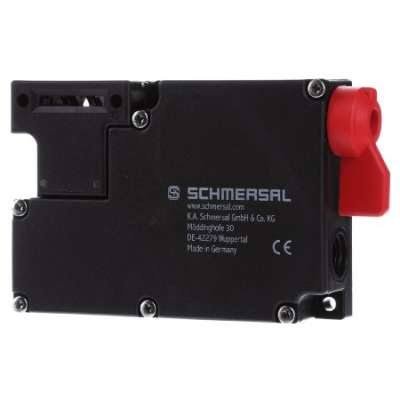
Some guard doors just need to be detected. Others need to stay locked shut until it is genuinely safe to open them – and that distinction is exactly where a solenoid safety-locking switch earns its place in a machine’s design. The Schmersal AZM300 is one of the most widely specified locking devices in that category, built to hold hazardous access points closed until a controlled run-down or process condition is met. As a trusted Schmersal supplier, Automabuy sources genuine AZM300 units with full compliance documentation, technical selection support, and delivery timelines that respect your production schedule. This guide covers what the AZM300 actually does, where it fits, how to size it correctly, and why sourcing it from a specialist supplier protects you from the most common and costly mistakes in machine guarding.
What Is the AZM300?
The AZM300 is a solenoid-interlocked safety switch from Schmersal’s AZM range, designed to both detect the position of a movable guard and physically lock it closed until it is safe to release. Unlike a basic position switch that only reports open/closed status, the AZM300 actively prevents the guard from being opened while hazardous motion – such as a spinning blade, a moving robot arm, or a coasting motor – is still in progress. It is typically used wherever a machine has a run-down time longer than the time it would take a person to reach the hazard once the guard is opened, which is the exact scenario solenoid locking exists to solve.
Built with a compact, robust housing and a coded, tamper-resistant actuator, the AZM300 is rated to relevant machine-safety standards, including EN ISO 14119 and IEC 60947-5-3, and can be specified with a performance level up to PL e / SIL 3 depending on wiring configuration, making it suitable for both moderate- and high-risk applications.
Why the AZM300’s Locking Function Matters
Standard interlocking without a lock only tells the control system that a guard has been opened it does nothing to prevent the guard from being opened too early. In applications where a machine element continues moving after power is cut (flywheels, spindles, extruders, large motors with high inertia), that gap between ‘stop signal sent’ and ‘motion actually stopped’ can be several seconds or more. The AZM300 closes that gap by keeping the guard physically locked until the hazard has genuinely cleared, verified either by a timer relay or a direct speed/standstill signal from the machine.
● Prevents premature access during machine run-down or coast-down
● Supports both power-to-lock and power-to-unlock configurations
● Coded actuator resists defeat with generic or substitute keys
● Integrates directly with Schmersal PROTECT safety relays and controllers
● Rated for high-risk applications up to PL e / SIL 3
Choosing the Right Schmersal AZM300 Supplier
Because the AZM300 carries a certified safety rating, the supplier behind it matters just as much as the part itself. A genuine unit from an authorised channel comes with documentation confirming its PL/SIL rating, wiring category, and coded-actuator specification, all of which an auditor or notified body will expect to see. Grey-market or counterfeit locking switches can look externally identical while lacking the certified solenoid mechanism or coded actuator logic that makes the fail-safe locking function legitimate. A knowledgeable Schmersal AZM300 supplier verifies these details before the unit ever reaches your panel, catching wiring-category mismatches, incorrect actuator codes, and outdated part revisions that a generic industrial parts reseller has no reason to check.
AZM300 Configuration Options
| Configuration | Function | Typical Application |
| Power-to-Lock | The guard locks only while powered and unlocks on power loss | Applications requiring fail-safe unlock on power failure |
| Power-to-Unlock | The guard stays locked on power loss and unlocks only when powered | Process safety, high-inertia machinery |
| Escape Release | Manual override allows exit from inside guarded area | Enclosed machine cells, walk-in guarded zones |
| Auxiliary Release | External key-based manual unlock for maintenance | Emergency access, servicing |
How to Specify an AZM300 Correctly
Getting the specification right starts with the machine’s risk assessment, not the catalogue page. Key questions to work through before ordering include:
● Does the application need power-to-lock or power-to-unlock behaviour?
● What is the required Performance Level (PL) or SIL rating for this hazard?
● Is an escape or auxiliary release mechanism required for personnel safety?
● What run-down or coast-down time must the lock accommodate?
● Will the switch integrate with an existing PROTECT relay or safety PLC?
Skipping any of these steps is one of the most common reasons a correctly purchased locking switch still fails a safety audit the part was genuine, but the configuration didn’t match the actual hazard.
Industries That Rely on AZM300 Locking Switches
Packaging and palletising lines use AZM300 units to lock guards around high-speed conveyor and robotic pick-and-place cells until motion has fully stopped. Automotive manufacturing relies on them around press and stamping equipment where flywheel inertia keeps components moving well after the power is cut. Food and pharmaceutical processing plants specify hygienic-rated variants to maintain washdown compliance around mixers, extruders, and centrifuges. Metal and heavy industry facilities use ruggedised AZM300 units around large motors and spindles with extended coast-down times, while material handling and automated storage systems apply them to guarded access points on high-speed retrieval equipment.
The Automabuy Sourcing Advantage
When you order an AZM300 through Automabuy, our technical desk first confirms the correct locking configuration, actuator coding, and PL/SIL rating against your stated application before the quote is even issued. Every unit is traceable to an authorised Schmersal channel, arrives with compliance documentation, and carries a manufacturer warranty. For clients managing multiple guarded access points across a facility, we maintain a record of previously supplied AZM300 variants per machine, so replacement orders are fast and accurate instead of requiring a fresh investigation each time a unit needs swapping. Urgent downtime situations are prioritised for expedited dispatch wherever inventory allows.
Frequently Asked Questions
What makes the AZM300 different from a standard safety switch?
The AZM300 includes a solenoid locking mechanism that physically prevents a guard from opening until a hazard has cleared, whereas a standard safety switch only detects guard position without preventing access.
Is the AZM300 suitable for high-risk applications?
Yes. Depending on wiring configuration, the AZM300 can achieve Performance Level PL e and SIL 3, making it suitable for both moderate- and high-risk machine guarding applications.
What is the difference between power-to-lock and power-to-unlock?
Power-to-lock switches unlock automatically if power is lost, while power-to-unlock switches Stay locked during a power failure – the correct choice depends on which failure mode is safer for your specific hazard.
Can Automabuy help identify the correct AZM300 configuration for my machine?
Yes. Our technical team reviews your risk assessment and machine run-down characteristics to recommend the correctly configured and rated AZM300 variant.
How quickly can a replacement AZM300 unit be shipped during downtime?
Automabuy prioritises urgent safety-critical orders and expedites dispatch wherever stock allows, minimising production downtime.
Conclusion
A solenoid-locking safety switch is one of the few components on a machine that actively prevents an accident rather than simply reporting one in progress – which is exactly why the correct specification and a genuine, traceable supply chain both matter so much. Automabuy’s technical sourcing team is ready to help you specify, quote, and deliver certified AZM300 locking devices for your next installation, retrofit, or emergency replacement.