






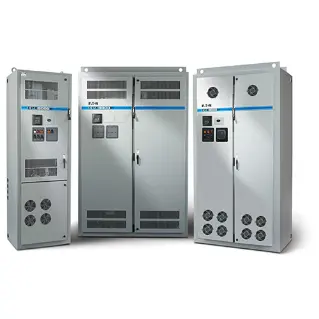
Running a motor at full speed when the process only needs half that output isn’t just wasteful — it’s one of the largest, most avoidable sources of energy loss on an industrial site. A variable frequency drive fixes exactly that problem by matching motor speed to actual process demand instead of running everything at a fixed line frequency. As a specialist Eaton VFD Supplier, Automabuy sources genuine Eaton drives across the full horsepower range, with application-specific sizing, commissioning support, and documentation that keeps your electrical and process engineers on the same page. This guide covers how VFDs actually work, the main Eaton product families, how to size and select the right drive, and why the supplier behind it matters as much as the drive itself.
What Does a Variable Frequency Drive Actually Do?
A variable frequency drive controls the speed and torque of an AC induction motor by converting incoming fixed-frequency utility power into a variable-frequency, variable-voltage output. Internally, the drive rectifies incoming AC to DC, smooths it through a DC bus, and then uses an inverter section to synthesise a new AC waveform at whatever frequency the application requires. Because motor speed is directly proportional to the frequency of the supplied power, this allows continuous, precise control over motor speed rather than the abrupt on/off or fixed-speed operation of a motor connected straight to line power.
Why an Eaton VFD Supplier Makes the Difference
Eaton’s drive range is built around two things process engineers care about most: energy savings and reliability under real industrial conditions. Because motor power consumption scales roughly with the cube of speed on many centrifugal loads, even a modest reduction in required speed can produce substantial energy savings — a fan or pump running at 80% speed can use roughly half the power of one running at 100%. But realising those savings depends on correct sizing and configuration, which is exactly why working with an experienced Eaton VFD Supplier matters: Eaton drives add built-in harmonic mitigation, coordinated protection with upstream breakers, and communication protocols that integrate directly into a plant’s existing SCADA or building management system, but only when specified correctly for the application.
Eaton VFD Product Range
| Drive Series | Typical Power Range | Common Application |
| PowerXL DG1 | 0.25 HP – 550 HP | General-purpose motor control |
| PowerXL DH1 | 1 HP – 900 HP | HVAC fans and pumps |
| PowerXL DC1 | 0.5 HP – 500 HP | Compact panel-mount installations |
| Medium Voltage Drives | 200 HP – 12,000+ HP | Large compressors, mills, extruders |
How to Select and Size the Right VFD
Sizing a VFD correctly requires more than matching the motor’s nameplate horsepower to a drive rating. Key factors to confirm before ordering include:
● Motor nameplate current and voltage, plus expected duty cycle
● Load type — variable torque (fans/pumps) vs constant torque (conveyors, mixers)
● Required overload capacity for starting torque or process surges
● Harmonic mitigation requirements based on facility power quality standards
● Enclosure rating needed for the installation environment (NEMA 1, 12, or 4X)
Undersizing a drive for the actual starting torque required is one of the most common mistakes in VFD specification – a motor that runs fine at steady speed can still stall or trip the drive during startup if the inrush and breakaway torque were never properly accounted for.
Key Benefits of Genuine Eaton VFDs
● Significant energy savings on variable-torque loads like fans and pumps
● Soft-start capability that reduces mechanical stress on driven equipment
● Built-in diagnostics and fault logging for faster troubleshooting
● Compatibility with common industrial communication protocols
● Coordinated protection design alongside Eaton circuit breakers and contactors
Industries That Rely on Eaton VFDs
HVAC and building automation systems use VFDs extensively on fans and pumps to match airflow and water flow precisely to occupancy and load conditions, cutting energy costs significantly compared to constant-speed operation. Water and wastewater treatment plants rely on drives to control pump speed for consistent flow rates across varying demand throughout the day. Manufacturing facilities apply VFDs to conveyors, mixers, and extruders where precise speed control directly affects product quality and throughput. Oil, gas, and heavy industrial sites specify medium-voltage drives for large compressors and mills where the sheer scale of the motor makes energy efficiency gains especially significant on the operating budget.
The Automabuy Sourcing Advantage
When you order a VFD through Automabuy, our technical desk first reviews your motor nameplate data, load type, and application requirements before a quote is issued, ensuring the drive you receive is correctly rated for both steady-state operation and startup conditions. Every unit shipped is traceable to an authorised Eaton channel, arrives with compliance documentation, and carries a manufacturer warranty. For clients managing multiple motor-driven systems across a facility, we maintain records of previously supplied drive models per application, making future capacity upgrades or replacements straightforward rather than a fresh specification exercise each time. Priority dispatch is available for facilities facing unplanned downtime on critical process motors.
Frequently Asked Questions
How much energy can a VFD actually save?
On variable-torque loads like fans and pumps, running a motor at 80% speed instead of 100% can reduce power consumption by roughly half, since power draw scales approximately with the cube of speed on these load types.
What is the difference between variable torque and constant torque applications?
Variable torque loads like fans and pumps require less torque at lower speeds, while constant torque loads like conveyors and mixers need consistent torque across the full speed range — this distinction determines drive sizing and overload rating.
Do Eaton VFDs require special enclosures for harsh environments?
Yes, Eaton offers NEMA 1, 12, and 4X rated enclosures depending on installation conditions, from clean indoor panels to washdown or outdoor environments.
Can Automabuy help size a VFD for an existing motor?
Yes. Our technical team reviews your motor nameplate data, load type, and starting torque requirements to recommend the correctly sized and rated Eaton VFD.
How quickly can a replacement VFD be shipped during unplanned downtime?
Automabuy prioritises urgent process-critical orders and works to expedite dispatch wherever stock allows, minimising production downtime.
Conclusion
A variable frequency drive is one of the few upgrades on an industrial site that pays for itself directly through energy savings while also extending equipment life through gentler starts and precise speed control. Getting the sizing, load type, and protection coordination right from the start is what separates a drive that performs reliably for a decade from one that trips repeatedly under real operating conditions. Automabuy’s technical sourcing team is ready to help you specify, quote, and deliver the right Eaton VFD for your next installation or motor upgrade.