






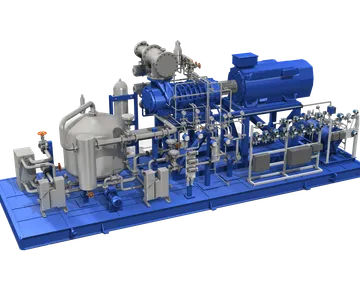
Moving gas efficiently from wellhead to pipeline to processing facility depends on compression equipment engineered for the specific job at each stage – screw compressors for continuous low-to-mid pressure boosting, centrifugal compressors for high-volume pipeline transmission, and specialised rotary equipment for gas gathering in demanding field conditions. Few manufacturers cover that range as comprehensively as Howden, and few applications punish a poorly specified compressor as quickly as oil and gas service does. As a specialist supplier of Howden Gas Compression Equipment, Automabuy sources genuine screw compressors, centrifugal packages, and rotary equipment across Howden’s oil and gas range, with application-specific sizing support and full documentation. This guide covers the core equipment categories, how to select the right technology for your application, and why sourcing through a knowledgeable supplier matters in this demanding sector.
Why Compression Technology Choice Matters in Oil & Gas
Unlike many industrial applications where a single compressor type covers most needs, oil and gas operations routinely require several distinct compression technologies working together across a single processing chain. Wellhead and gathering applications often favour rotary or screw technology for their tolerance of variable inlet conditions and entrained liquids. Pipeline transmission and large-scale gas boosting typically favour centrifugal compressors for their efficiency at high continuous flow rates. Vapour recovery and flare gas capture applications have their own specific requirements around turndown ratio and intermittent operation. Choosing the wrong technology for a given stage doesn’t just underperform; it can introduce reliability problems that ripple through the rest of the process.
Core Equipment Categories in the Howden Range
| Equipment Type | Core Strength | Typical Application |
| Screw Compressors | Continuous operation, tolerance for variable inlet conditions | Gas gathering, vapor recovery |
| Centrifugal Compressors | High efficiency at large continuous flow rates | Pipeline transmission, large-scale boosting |
| Rotary Equipment | Robust handling of entrained liquids and solids | Wellhead and field gathering service |
| Vapor Recovery Units | Wide turndown for intermittent flare gas capture | Tank vapor recovery, flare gas reduction |
Why the Right Howden Gas Compression Equipment Supplier Matters
Selecting compression technology isn’t a catalogue exercise; it requires reviewing the actual gas composition, inlet conditions, turndown requirements, and downstream process needs against the full range of available equipment options. A knowledgeable Howden Gas Compression Equipment supplier reviews these details before recommending a specific technology and configuration, catching mismatches, like specifying a centrifugal compressor for an application with highly variable inlet flow that would actually suit screw technology better, before they become an underperforming, unreliable installation.
How to Select the Right Compression Technology
Working through these questions helps identify the correct equipment category before requesting a quote:
● What is the actual gas composition, including any entrained liquids or solids?
● Is inlet flow steady and continuous, or does it vary significantly over time?
● What turndown ratio does the application require for varying demand?
● What are the required discharge pressure and overall compression ratio?
● What space, noise, and emissions constraints apply to the installation?
Overlooking inlet flow variability is one of the more consequential oversights in compression technology selection. Equipment optimised for steady continuous operation can experience accelerated wear or control instability when actual field conditions turn out to be considerably more variable than initially assumed.
Key Benefits of Genuine Howden Equipment
● Broad technology range covering multiple stages of the gas compression chain
● Proven reliability across decades of oil and gas field deployment
● Engineering support for application-specific configuration and sizing
● Compatibility with modern process control and monitoring integration
● Strong parts and service support for long-term operational reliability
Industries and Applications That Rely on Howden Equipment
Upstream operators use screw and rotary compression extensively for wellhead and gathering line service where variable inlet conditions and entrained liquids are routine. Midstream operators rely on centrifugal compression for pipeline transmission, where efficiency at sustained high flow rates directly affects transportation economics. Gas processing facilities apply a mix of technologies across different compression stages depending on gas composition and pressure requirements at each point in the process. Vapour recovery and flare gas capture initiatives, increasingly important for both environmental compliance and revenue recovery, rely on Howden’s wide-turndown equipment to handle intermittent and variable gas volumes efficiently.
The Automabuy Sourcing Advantage
When you contact Automabuy for gas compression equipment, our technical desk reviews your gas composition, inlet conditions, and downstream requirements before recommending a specific Howden technology and configuration, rather than defaulting to whichever equipment type is most familiar. Every unit supplied is genuine, traceable to an authorised Howden channel, and accompanied by documentation and a manufacturer warranty. For operators managing multiple compression stages across a facility or field, we maintain records of previously supplied equipment per application, making future capacity additions and replacements straightforward instead of a fresh specification exercise each time.
Frequently Asked Questions
When should screw compression be used instead of centrifugal technology?
Screw compressors are generally better suited to applications with variable inlet conditions or entrained liquids, such as gas gathering, while centrifugal compressors excel at high, continuous flow rates typical of pipeline transmission.
What makes rotary equipment suitable for wellhead service?
Rotary compression technology is generally more tolerant of entrained liquids and solids common at the wellhead, where gas composition can be less consistent than further downstream.
Why is the turndown ratio important for vapour recovery applications?
Vapour recovery and flare gas capture often involve intermittent or highly variable gas flow, making wide turndown capability essential for equipment to operate efficiently across the full range of actual conditions.
Can Automabuy help select the right compression technology for my application?
Yes. Our technical team reviews your gas composition, inlet conditions, and process requirements to recommend the correctly configured Howden equipment for your specific application.
Does Howden equipment support integration with modern process control systems?
Yes, Howden’s compression equipment is generally compatible with modern process control and monitoring integration, supporting centralised facility management.
Conclusion
Oil and gas compression rarely relies on a single equipment type it depends on matching the right technology to each specific stage of the gas handling chain, from variable wellhead conditions through steady pipeline transmission to intermittent vapour recovery duty. Automabuy’s technical sourcing team is ready to help you specify, quote, and deliver the right Howden Gas Compression Equipment configuration for your next installation, expansion, or field development project.