







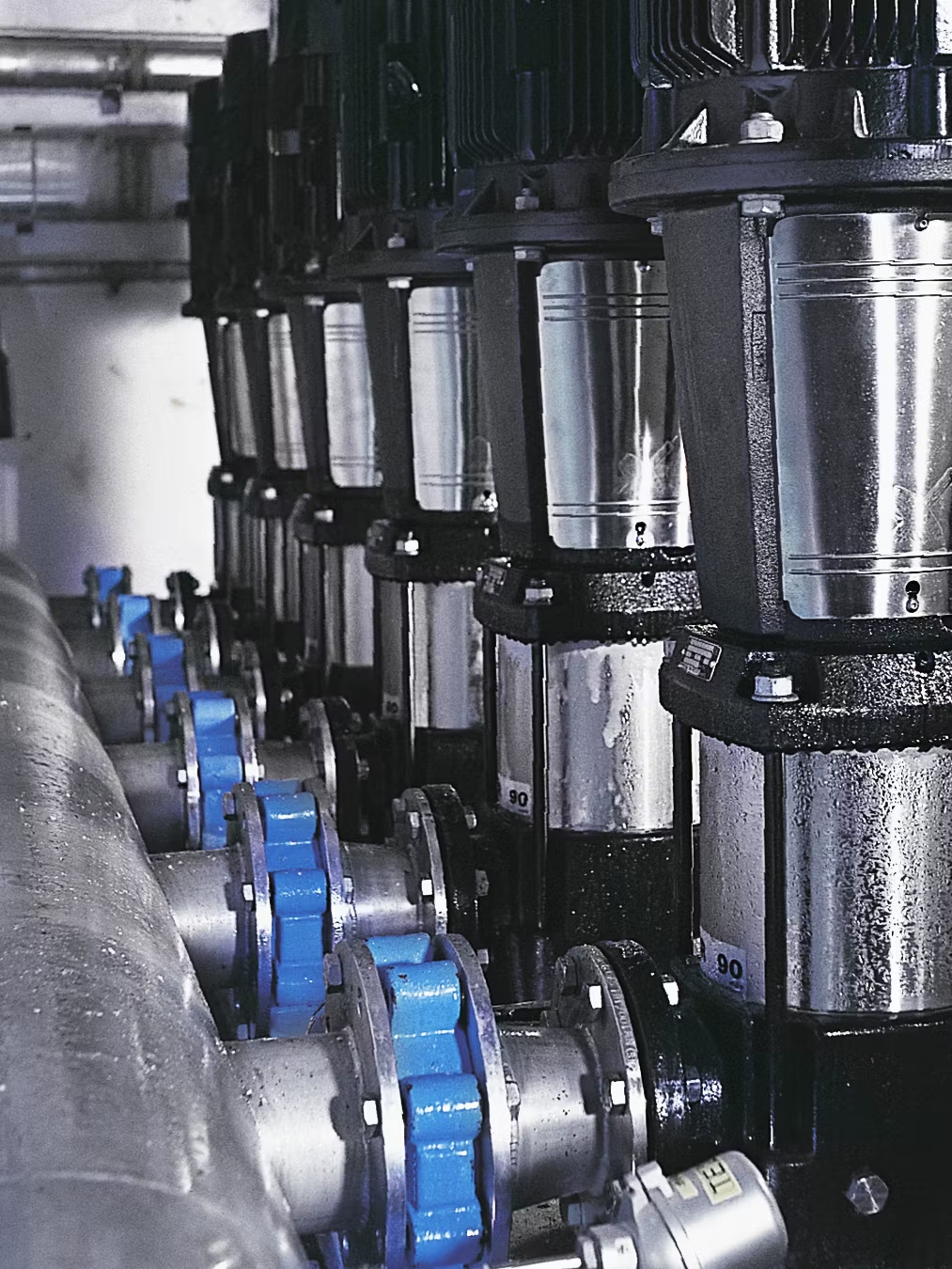
Some applications need more than flow – they need pressure, precisely built up in controlled stages rather than forced through a single oversized impeller that wastes energy and sacrifices efficiency at part-load conditions. That’s the exact engineering problem a multistage centrifugal pump solves, and it’s why the Grundfos CR series has become a default specification across high-pressure industrial applications worldwide. As a specialist Grundfos Multistage Pump Supplier, Automabuy sources genuine CR-series pumps across the full stage count and material range, with application-specific sizing support and full documentation. This guide covers how multistage pumps work, where they outperform single-stage alternatives, how to select the right configuration, and why sourcing through a knowledgeable supplier matters for industrial-grade reliability.
How Multistage Pumps Build Pressure Differently
A multistage centrifugal pump stacks multiple impeller-and-diffuser stages in series along a common shaft, with the discharge of each stage feeding directly into the suction of the next. Rather than relying on one large impeller spinning at high speed to generate the required head, the pump builds pressure incrementally across each stage, allowing the same total head to be achieved with smaller, more efficient impellers running at a shared speed. This staged approach typically delivers better efficiency across a wider operating range than an equivalent single-stage design attempting to generate the same pressure in one step.
Why an Experienced Grundfos Multistage Pump Supplier Matters
Stage count, impeller trim, and material selection all interact in ways that aren’t always obvious from a standard catalogue listing, and getting any of these wrong can mean a pump that technically runs but never quite hits its intended duty point efficiently. An experienced Grundfos Multistage Pump Supplier reviews the actual system curve – not just a single flow-and-head number – against the correct CR model and stage configuration, catching a mismatch between pump curve and system curve before it becomes an underperforming installation that seems to run fine but quietly wastes energy for years.
CR Series Configuration Range
| Configuration | Key Feature | Typical Application |
| Standard Stainless CR | General industrial multistage duty | Water supply boosting, process transfer |
| High-Pressure CRE (E-Motor) | Integrated variable speed control | Variable demand pressure boosting |
| High-Temperature Variant | Seal and material options for elevated temperature | Boiler feed, hot water circulation |
| Chemical-Duty Variant | Extended material compatibility options | Chemical dosing, corrosive fluid transfer |
How to Select the Right Multistage Configuration
Correct selection depends on matching the full system curve to the pump’s performance curve rather than a single design point. Key factors to confirm before ordering include:
● Required flow rate and total dynamic head across the actual operating range
● Whether variable demand justifies an integrated variable speed E-motor
● Process fluid temperature and required material or seal compatibility
● Available electrical supply and space constraints for the installation
● NPSH available at the installation versus NPSH required by the selected model
Overlooking available NPSH is one of the more consequential oversights in multistage pump selection — a pump that looks perfectly sized on a flow-and-head chart can still cavitate destructively if suction conditions weren’t properly evaluated during specification.
Key Benefits of Genuine Grundfos CR Pumps
● High efficiency across a wide range of operating points
● Compact vertical footprint suited to space-constrained mechanical rooms
● Cartridge-style shaft seal simplifying maintenance and replacement
● Integrated variable speed options reducing energy costs on variable-demand systems
● Proven reliability across decades of industrial and commercial installations
Industries That Rely on Multistage Pump Technology
Commercial and residential high-rise buildings depend on CR-series pumps for domestic water pressure boosting across dozens of floors where consistent pressure is essential regardless of demand fluctuations. Industrial process facilities apply multistage pumps to boiler feedwater, reverse osmosis feed, and other high-pressure process transfer applications. District cooling and HVAC systems use CR pumps extensively for chilled water circulation where efficient part-load performance directly affects operating costs. Chemical and pharmaceutical facilities rely on chemical-duty variants for precise, high-pressure dosing and transfer applications where material compatibility is critical.
The Automabuy Sourcing Advantage
When you order a CR-series pump through Automabuy, our technical desk reviews your complete system curve, fluid characteristics, and installation constraints before recommending a specific stage count and material configuration, rather than defaulting to a single flow-and-head data point. Every unit shipped is genuine, traceable to an authorised Grundfos channel, and accompanied by documentation and a manufacturer warranty. For facilities managing multiple pressure-boosting or process pumps, we maintain records of previously supplied configurations per installation, making future replacements and capacity upgrades straightforward instead of a fresh specification exercise each time.
Frequently Asked Questions
Why does a multistage pump perform better than a single-stage pump at high pressure?
A multistage pump builds pressure incrementally across several smaller, more efficient impeller stages rather than forcing one large impeller to generate the entire pressure rise, typically resulting in better efficiency across a wider operating range.
What is the CRE variant, and when should it be used?
The CRE variant integrates a variable-speed motor directly into the pump, making it well suited to applications with variable demand where speed modulation improves energy efficiency compared to a fixed-speed pump.
Why does NPSH matter when selecting a multistage pump?
If the available net positive suction head at the installation is lower than what the pump requires, the pump can experience cavitation, causing damage and performance loss even if the flow and head rating otherwise match the application.
Can Automabuy help select the right CR configuration for my system?
Yes. Our technical team reviews your complete system curve, fluid characteristics, and installation constraints to recommend the correctly configured Grundfos CR model.
Are chemical-duty multistage pumps available for corrosive fluid transfer?
Yes, chemical-duty CR variants offer extended material compatibility options suited to chemical dosing and corrosive fluid transfer applications.
Conclusion
Multistage pump technology solves a genuinely difficult engineering problem generating substantial pressure efficiently across a wide operating range and getting the stage count, material, and motor configuration right is what determines whether that efficiency advantage is actually realised in the field. Automabuy’s technical sourcing team, as your trusted Grundfos Multistage Pump Supplier, is ready to help you specify, quote, and deliver the right CR-series configuration for your next installation or process upgrade.